Reviewed by Brian Benkendorf, Director of Design & Development
This case study outlines how Hi-Tech Seals specified a PTFE spring energized seal for a downhole telemetry tool, resolving low-pressure leakage and reducing friction on mating metal components in a harsh wellbore environment.
Customer Profile
The client is an industry leader in oilfield telemetry, based in North America. Their work involves downhole telemetry tools deployed into wellbore environments exposed to high pressure, elevated temperatures, aggressive fluids, and abrasive particles.
Application
Downhole telemetry tools transmit measurement data from instruments near the bottom of the drill string to surface monitoring equipment during drilling. These tools are commonly used in measurement-while-drilling (MWD) applications to provide directional survey data, including wellbore inclination and azimuth.
The sealing component requires both static and dynamic sealing. The seal isolates the tool's internal clean fluid from the wellbore environment, including oil, hydrocarbons, H₂S, sand, and Lost Circulation Material (LCM), at temperatures up to 175°C and high pressures. The tool runs on battery power for the duration of a drilling run.
The Challenge
The final sealing component must seal out the harsh wellbore environment from the tool’s clean fluids while keeping friction low enough to avoid affecting battery life. The existing design used a thermoplastic copolyester elastomer (TPC-ET) such as Hytrel®. Although it sealed effectively at higher pressures, it experienced leakage at lower pressures, and its high friction contributed to wear on the metal components.
Hi-Tech Seals Solution
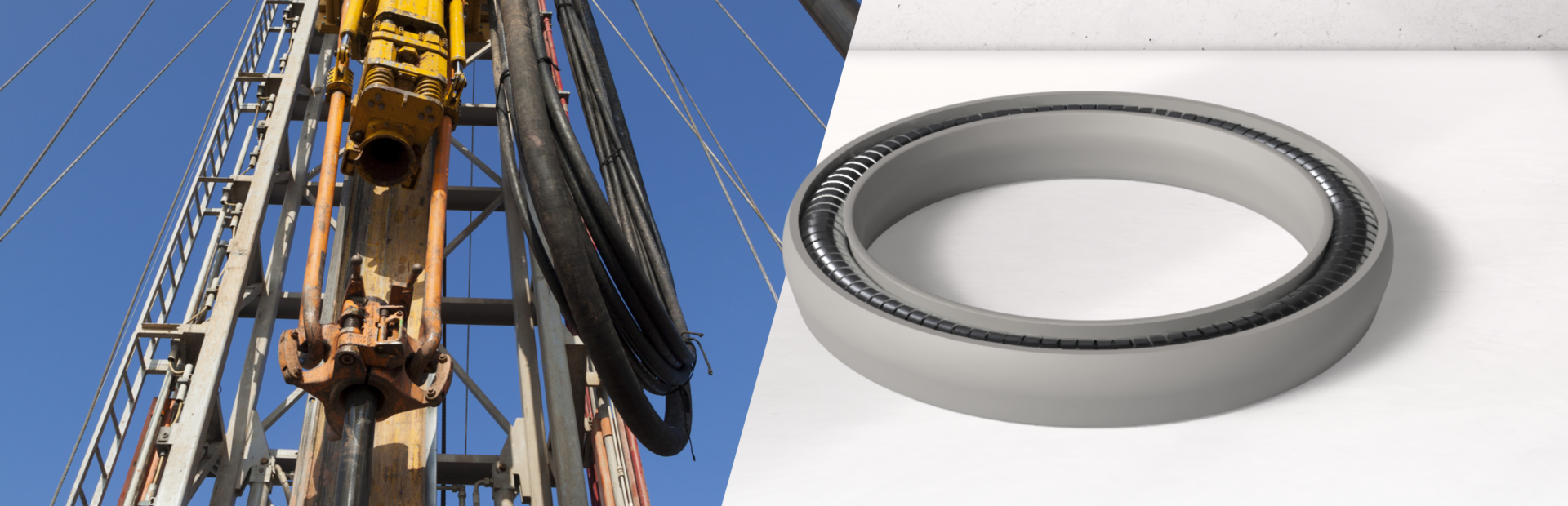
After reviewing several potential sealing solutions, including designs that posed challenges with installation and friction, our team determined that a PTFE spring energized seal proved to be the best solution. Spring energized seals are lip seals that incorporate a metal or composite spring into the seal design. The spring energizes the seal lip against the mating hardware, creating a seal capable of compensating for movement in a dynamic application.
The spring energized seal used a helical wound spring providing highly engineered lip loading on the sealing surfaces. The spring maintains sealing force at the lip independent of system pressure, which addresses the low-pressure leakage.
The final material design used carbon-reinforced PTFE for the seal jacket. PTFE's low coefficient of friction helped reduce friction against mating metal components, and its excellent chemical resistance properties made it well-suited to the harsh wellbore environment. Carbon reinforcement improves the wear resistance and mechanical stability under load of the PTFE at elevated temperatures.
A KasPex™ PEEK backup ring is added to the gland, blocking the extrusion path and resisting PTFE cold flow to maintain sealing integrity at high pressure.
The Results
The spring energized seal significantly reduced friction and eliminated the wear patterns previously seen on the tool’s metal components. The low-friction properties of the PTFE jacket did not impose a friction load that would contribute to the reduction of battery life. The seal also held pressure across the full operating range, resolving the low-pressure leakage seen with the previous thermoplastic design.