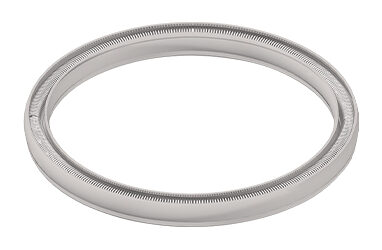
What Are Spring Energized Seals?
Spring energized seals are lip seals that incorporate a metal or composite spring into the seal design. The spring maintains a constant load on the seal lip, compensating for wear, thermal expansion and contraction, and misalignment. They are typically single-acting, function in both static and dynamic applications, and must be oriented with the spring toward the pressure side.
Spring energized seals are primarily used in extreme environments where standard molded thermoplastic or elastomeric seals cannot meet the application requirements. This can include applications involving high pressure, elevated or cryogenic temperatures, chemically aggressive media, or where reliable low friction sealing is essential. As each application carries different performance requirements, Hi-Tech Seals primarily supplies custom-designed spring energized seals.
Please see our case study on how we supported downhole oilfield telemetry tools with specialized spring energized seals: Spring Energized Seals for Downhole Oilfield Telemetry.
Installation of spring energized seals can often be challenging. For this reason, they are strongly recommended to be used in open or split gland designs.
Spring Energized Seal Applications
Spring energized seals are used wherever standard seal materials fail. Common sealing applications include:
- Valves and valve stems
- Hydraulic cylinders
- Pneumatic cylinders
- Pump shafts
- Compressors
- Rotating shafts
- Oscillating shafts
- Downhole tools
- Wellhead equipment
- Cryogenic equipment
- Vacuum equipment
- Aerospace fuel systems
Designing a Spring Energized Seal
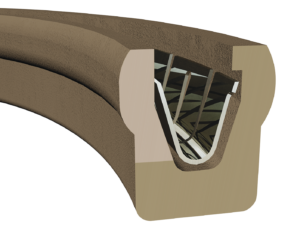
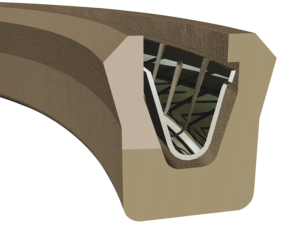
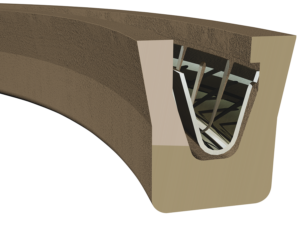
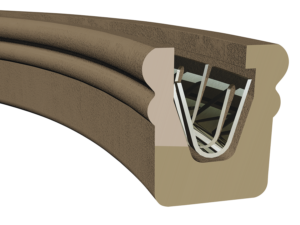
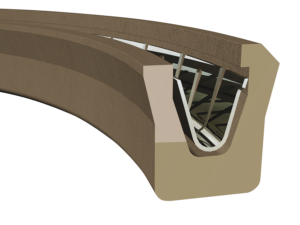
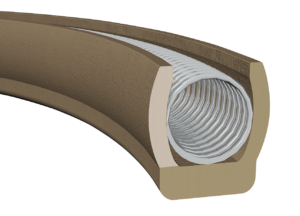
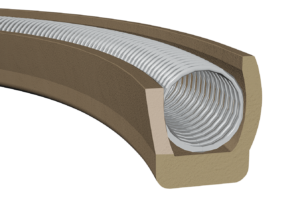
1. Select a dynamic lip configuration
| Seal Type | Advantages | Disadvantages |
  |
|
|
  |
|
|
 |
|
|
 |
|
|
 |
|
|
 |
|
|
 |
|
|
Images are depicted with a bronze reinforced PTFE material.
2. Static Lip Configuration
Determine if the same sealing lip is appropriate for the static lip. Spring energized seals do not have to be symmetrical.
3. Select a Seal Jacket Material
When choosing the seal jacket material required for the application, variables to consider include:
- Temperature
- Chemical
- Pressure
- Velocity
- Cost
| Seal Materials | Temp. Range | ||
|---|---|---|---|
| Polytetrafluoroethylene (PTFE) | -260°C to 260°C | ||
| Carbon/Graphite Reinforced PTFE | -200°C to 260°C | ||
| Glass/Moly Reinforced PTFE | -200°C to 260°C | ||
| Bronze Reinforced PTFE | -200°C to 260°C | ||
| Carbon Reinforced PTFE | -200°C to 260°C | ||
| KasPex™ PEEK | -70°C to 260°C | ||
| UHMW-PE | -250°C to 80°C | ||
4. Choose a Spring Type
Cantilever Spring (V-Spring or Finger Spring) | |
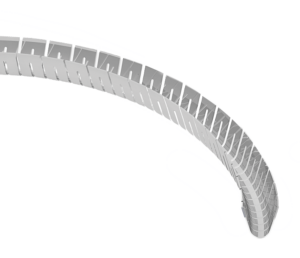 | A cantilever spring is recommended for dynamic, medium load applications where low friction is desired. The V-shape spring provides constant compression load and is further energized by system pressure. |
Helical Wound Spring | |
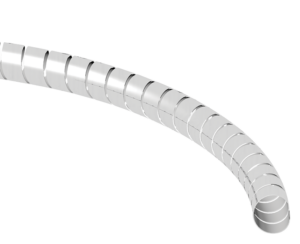 | A helical wound spring is made from a metal ribbon, which is coiled into a helix. The spring compresses radially, producing an extremely high load versus deflection, resulting in tight sealing. The helical wound spring is preferred for static or low-speed applications or in applications where sealability takes priority over friction. |
Slanted / Canted Coil Spring | |
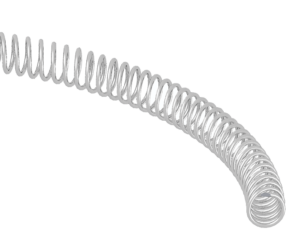 | A slanted coil spring, also known as a canted coil spring, is manufactured from a round wire that is coiled and angled. The process creates a compression force in the radial direction. The canted coil design is suited for dynamic applications where low friction is critical. |
5. Choose a Spring Material
The most common spring material is stainless steel. Hastelloy®, Inconel, and Elgiloy are available for applications that require additional corrosion resistance.